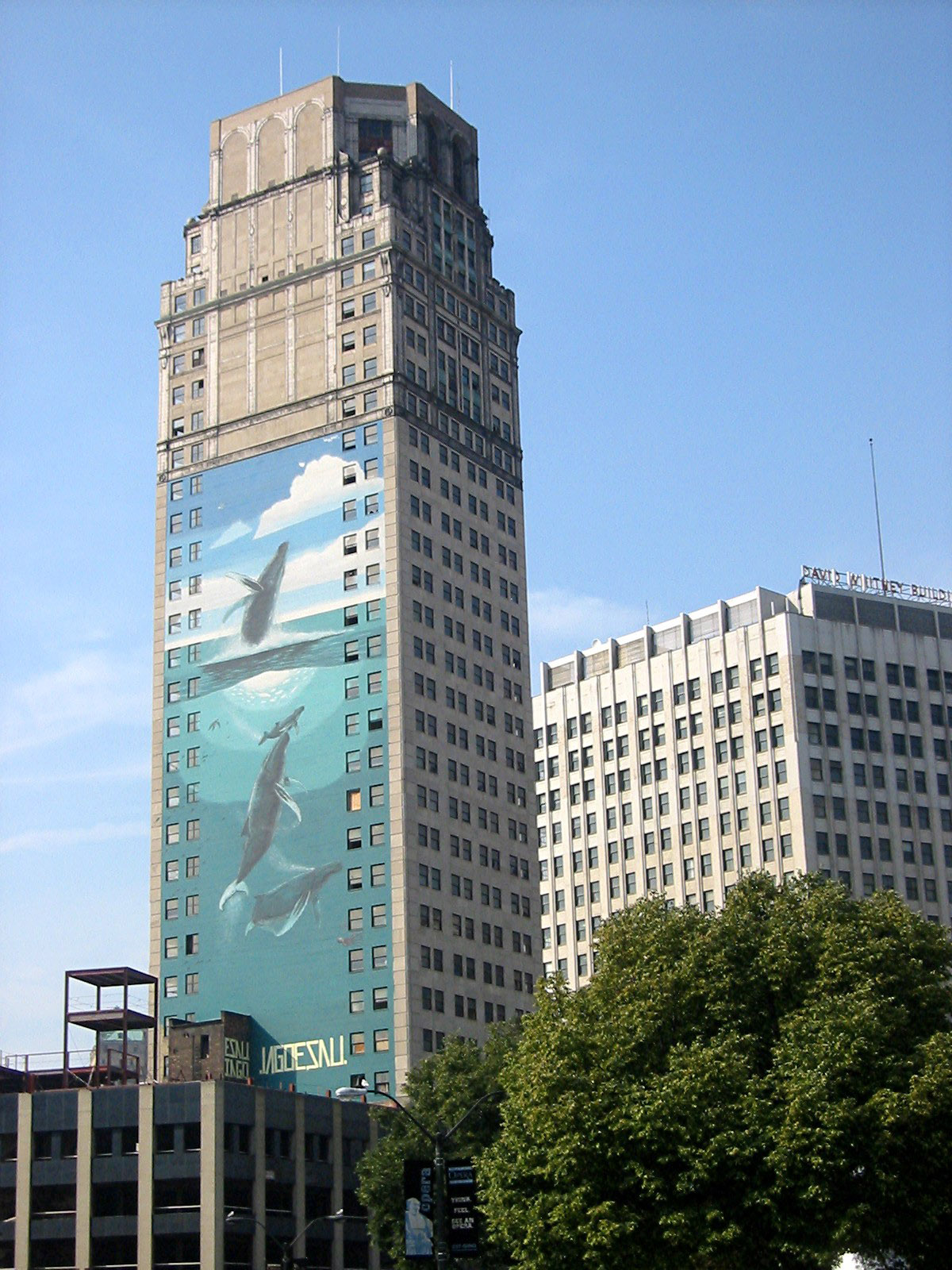
David Broderick Building/Eaton Tower
10 Witherall at Grand Circus Park in downtown Detroit
Throughout the 1990s, Detroit was the only major
city in the country with a building best known for a painting of a humpback
whale. After the Detroit Tigers moved into Comerica
Park in April, 2000, most fans could
easily see the
whale. During the dismal 2003 season when the Tigers lost 119 of 162 games, I quite often sat in Comerica
and looked at the attractive painting. Likely, there were many people who
knew this building best for the painting of a whale on its side. The whale is now
gone,
replaced by an advertisement for Daimler Chrysler’s Jeep but that was removed after the Damiler and Chrysler firms sepeerated.
The nation—and Detroit—experienced a brief recession after the end of World War I in 1919. The next decade was one of two in which Detroit’s economic base boomed and its population grew rapidly. By 1930, Motown was the nation’s fourth largest city. The 1940s, when World War II stimulated growth, was the other comparable decade. In terms of architecture, the 1920s were the years in which numerous spectacular and many functional buildings were constructed throughout the city
Downtown Detroit had a number of pre-World War I skyscrapers, including the nearby Ford and Dime buildings, but their number increased greatly in the 1920s. The building you see at Grand Circus Park was originally called the Eaton Tower. Most of it resembles a typical Chicago-school type skyscraper with the architects seeking to maximize use of valuable downtown space. Note the shaft of some 29 stories. But rather than stopping at that level, the architects added a five-story Beaux Arts topping. Presumably, this was to break up the symmetry of the lower floors, but I am not sure that their aim was accomplished. Critics have suggested the top looks like a wedding cake placed atop the major shaft. Apparently, there was once much ornamental decoration on the upper floors and around the top of this building, but that was removed. I have seen pictures of this building in the 1930s or 1940s when the Beaux Arts component was beautifully lit. The space for this tower was so small that the offices could not be arranged around a central core of elevators nor was there room for a light well. The lifts had to be lined up on the northwest wall. This had the effective of giving the building a very large blank side—a rather unattractive feature. To add some life to this slender building, an artist, Wyland, painted a seascape of the whale on the large exterior wall in the late 1980s, although I do not know the exact date.
Theodore Eaton made his fortune in the chemical industry in Detroit in the late Nineteenth Century. He was one of many millionaires in the city prior to the coming of the vehicle industry. His son, Theodore H. Easton, continued in the business of wholesaling and importing chemicals and dyes. He had this building constructed. I presume that he used some of it for his firm’s office and rented out the remainder. When completed, this was the second tallest building in Michigan. It was sold in 1945 to a prosperous Detroit insurance broker, David Broderick, who applied his own name and managed it until his death in 1957. It then passed through many owners until, 1976, when it was purchased by the Higgins family. The demand for office space in downtown Detroit collapsed in the 1980s. The building became vacant except for a ground floor restaurant by the end of the 1980s.
On September 20, 2006, the Detroit Free Press reported that Governor Jennifer Granholm and the Michigan Economic Development Corporation approved seven million dollars in tax credits for the renovation of the Broderick Building. Michael Higgins announced that the first four or five stories were be used for commercial purposes, while the higher 27 stories would be converted into 127 rental apartments. Those efforts were delayed. However, I spoke with Mr. Higgins in late 2010 and he assured me that renovation would soon begin. The website suggests that it was be a very upscale property. Mr. Higgins was eventually successful in renovating the Broderick Tower. By mid-2012, the first four stories were devoted to retail space and offices. Floors 5 to 24 each provided space for five apartments. Floors 25 to 34 were designated for penthouse use with, I believe, three penthouses per floor. In recent years, the demand for residential space in downtown Detroit has increased as employment there increases. By late 2012, I think that all or almost all of the units in the Broderick Tower were rented. This is a great tribute to the work of Mr. Higgins and a symbol of the gradual reinvorization of downtown Detroit, thanks to the arrival of General Motors, Quicken Loans, Blue Cross-Blue Shield, the new stadia and the three casinos.
This building is not listed on the National or State registers of historic sites. I believe that it is located within both the Grand Circus Park Historic District that is registered with both the State of Michigan Office of Historic Preservation and the National Park Service’s Register of Historic Places.
Date of completion: 1928
Architects: Louis and Paul Kamper
Architectural style: Chicago skyscraper with classical and Beaux Arts elements
Exterior material: Gray limestone
Use in 2012: Retail and commereical space on first four floors; residential on floors 5 to 34
Website: http://BroderickTower.com/
Photograph: Ren Farley
Description updated: December, 2012