
Mariner's Church
170 East Jefferson at the southeast corner of East Jefferson and Bates at the entrance to the tunnel to Canada and never out of the shadow of the Renaissance Center
This is a pre-Civil War building, one of the city's many spectacular churches and one with a long history. John Anderson was assigned to Detroit in 1818 as a brevet lieutenant colonel with the U. S. Topographical engineers who were assigned to explore and map the Michigan territory. He had graduated from West Point. His wife, Julia Ann Taylor Anderson, arrived with him in 1818 to the small settlement of Detroit. Census 1820 counted 1442 residents in the village. By the mid-1840s, the Andersons had died. Julia Ann Anderson and her sister, Charlotte Taylor, left their estates to found an Episcopalian church to serve the spiritual needs of the many sailors who came to the busy port of Detroit. Both of the Andersons had been active suppporters of the American Seaman's Friend Society—an organization that provided services to sailors. In 1848, the state legislature approved the incorporation of Mariner's Church. The executors of the estate selected Calvin N. Otis of Buffalo to design the church. This structure was built on land at the corner of Woodward and Jefferson that Colonel Anderson had purchased. Calvin Otis' other great contribution to Detroit's architectural heritage is the Church of the Messiah, now located at East Grand Boulevard and East Lafayette
Otis selected coarse gray limestone for
the structure with sandstone trim. Most of this stone came from the Lake
Erie
islands since attempts to secure stone from closer do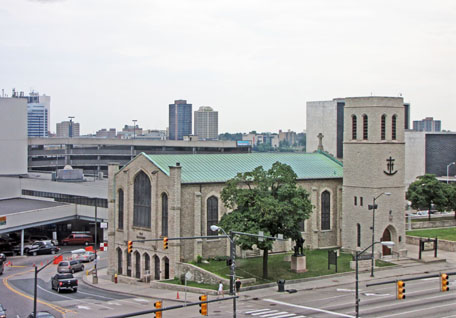 wnriver sites proved
futile.
Mariners is the oldest stone church in Michigan and the second oldest continuously-operating
church in the state. It is a rectangular, front-gabled Gothic Revival building
with an attractive crenellated roofline. Substantial towers mark
the four corners. The sharply sloping roof is supported by that quintessential
19th century engineering tool—an array of Howe trusses. The central
rose windows display a mariner's wheel and compass. Another window shows
Christ
calming a tempest. Finding monies to support a church has always been
a challenge.
When built, the first floor was designed for shops. Indeed, Detroit's post
office was located on the first floor of this church for some time in the
pre-Civil War years. Later a wholesale fruit and produce firm occupied the street level business space. Worshipers had to go to the second floor. The basement area that is visible from the ramp to the Detroit-Windsor tunnel is the part of this church that once housed the post office and produce firm.
wnriver sites proved
futile.
Mariners is the oldest stone church in Michigan and the second oldest continuously-operating
church in the state. It is a rectangular, front-gabled Gothic Revival building
with an attractive crenellated roofline. Substantial towers mark
the four corners. The sharply sloping roof is supported by that quintessential
19th century engineering tool—an array of Howe trusses. The central
rose windows display a mariner's wheel and compass. Another window shows
Christ
calming a tempest. Finding monies to support a church has always been
a challenge.
When built, the first floor was designed for shops. Indeed, Detroit's post
office was located on the first floor of this church for some time in the
pre-Civil War years. Later a wholesale fruit and produce firm occupied the street level business space. Worshipers had to go to the second floor. The basement area that is visible from the ramp to the Detroit-Windsor tunnel is the part of this church that once housed the post office and produce firm.
When the massive building that became the Coleman Young Municipal Building was erected, Mariner's Church was moved 900 feet to its present location. This took place between December, 1954 and March, 1955. The attractive bell tower with its nautical symbol was added at that time. Similar to many other congregation, there has been controvery among the elders. For about a thirty year span beginning in the 1960, there was conflict between those who sought to maintain this church as an independent Episcopalian congregation and those who wanted much strong ties to the local Episcopalian diocese. This led to extensive litigation and several court rulings about control of this church. I believe the dispute ended in the mid-1990s. Since then the congregation has had the resouces to maintain its beautiful old building.
This church is now well known for its religious service and bell ceremony held each November to mark the loss of 29 lives in the sinking of the Edmund Fitzgerald—the last of the huge great lakes boats to be lost to the gales of November. Pastor Richard W. Ingalls learned of the November 10, 1975 sinking of that ship. Appreciating the hisotyu of the church, he later went to the tower and slowly tolled the bell 29 times. This got a great deal of favorable attention in the press and prompted Canadian songwrite Gordon Lightful to compose his now well-known The Wreck of the Edmund Fitsgerald.
Along the Jefferson Avenue side of Mariners Church, you will see Donald DeLue's impressive statue of President George Washington in Masonic regalia.. There is also a Michigan Historical marker commemorating the contributions of the U. S. Topographical engineers. Their Michigan offices were established on this site in 1837.
Many people appreciate Mariner's church by driving along East Jefferson. A much better sense of the church's elegance and beauty may be gained by walking toward the church in the attractive promenade that links the church to Hart Plaza, especially on a sunny spring or summer day when the flowers are in bloom. The humble but beautiful church—built less than four decades after fire destroyed the city—contrasts with the soaring Renaissance Center towers that represent the city's attempt to come back from the fires of the 1967 riot.
A 2012 book—cited below—displays impressive pictures of this church. On shows the structure in transit as it crossed East Jefferson. Another shows the church when businesses operated on the street level.

Architectural style: Gothic Revival, aka Perpendicular
Gothic because of its Tudor arched windows that were frequently used in 15th
and 16th century English churches.
Architect: Calvin N. Otis
Builder: Hugh Moffat
Date of construction: 1849
Architect for bell tower added in 1955: Giffels and Rossett
Stained glass windows dating from 1955: J. and R. Lamb
Date of removal to present location: 1955
For additional information: Marla O. Collum, Barbara E. Krueger and Dorothy Kostuch, Detroit's Historic Places of Worship (Detroit, Wayne State University Press, 2012)
Michigan Registry of Historic Places: P25168, Listed October 23, 1957
Michigan Historic Marker: Placed: June 27, 1997
National Register of Historic Sites: Listed: March 11, 1971
Use in 2012: Same as in 1849—Episcopalian Church
Photo: Ren Farley October, 2002
Description updated: December, 2012