St. Aloysius is the patron saint of youth. He
was born in Spain in 1568, the son of the Marquis of Castiglione. At
age 9, his father sent him to Florence to master Italian and Latin. At
this point, Aloysius became interested in the study of Roman Catholic saints. At
age eleven, he rejected the royal title and fortune that he would inherited
from his parents to devote himself to religious ideals. His parents
disagreed with his decision and encouraged him to assume his rank and his
wealth. However, he
wanted  to become a missionary in India. Finally, when Aloysius was
17, his parents allowed him to begin study to become a Jesuit priest. In
1591, the plague spread throughout Italy. Although not yet ordained,
Aloysius ministered to the sick at the Jesuit hospital in Rome. He
contracted the disease and died at age 23. He was canonized by Pope
Benedict XIII 137 years after his death. There is an interesting similarity
to Father Gabriel Richard who died from cholera while ministering to those
sick with that disease in Detroit in the 1830s.
to become a missionary in India. Finally, when Aloysius was
17, his parents allowed him to begin study to become a Jesuit priest. In
1591, the plague spread throughout Italy. Although not yet ordained,
Aloysius ministered to the sick at the Jesuit hospital in Rome. He
contracted the disease and died at age 23. He was canonized by Pope
Benedict XIII 137 years after his death. There is an interesting similarity
to Father Gabriel Richard who died from cholera while ministering to those
sick with that disease in Detroit in the 1830s.
Bishop Gallagher, who directed the Detroit diocese from 1918 through 1937, was an entrepreneur and spiritual leader who greatly increased the number of Catholic churches in Detroit. Casper Borgess was the second Bishop of the Detroit Roman Catholic Diocese. In 1873, he purchased Westminister Presbyterian Church that stood on this site. He converted that church to use as the home of St. Aloysius Parish. This was to serve Catholics living on the west side of downtown. I do not believe that it was defined as an ethnic, i.e., non-English language, parish. The first pastor, Father Ernest Van Dyke, served for more than forty years. Sts. Peter and Paul Church on East Jefferson had served as Cathedral for the diocese of Detroit, but that church was turned over to the Jesuit priests in about 1870. In 1877, St. Aloysius Church the former Westminister Presbyterian structure was selected as the temporary Cathedral for the diocese. By 1890, St. Patrick’s Church on Woodward at Parsons was completed and served as the cathedral for the diocese. Later, Most Blessed Sacrament church on Woodward was chosen to be the catdedral. St. Aloysius returned to its status as a regular parish. St. Patrick's burned in 1977.
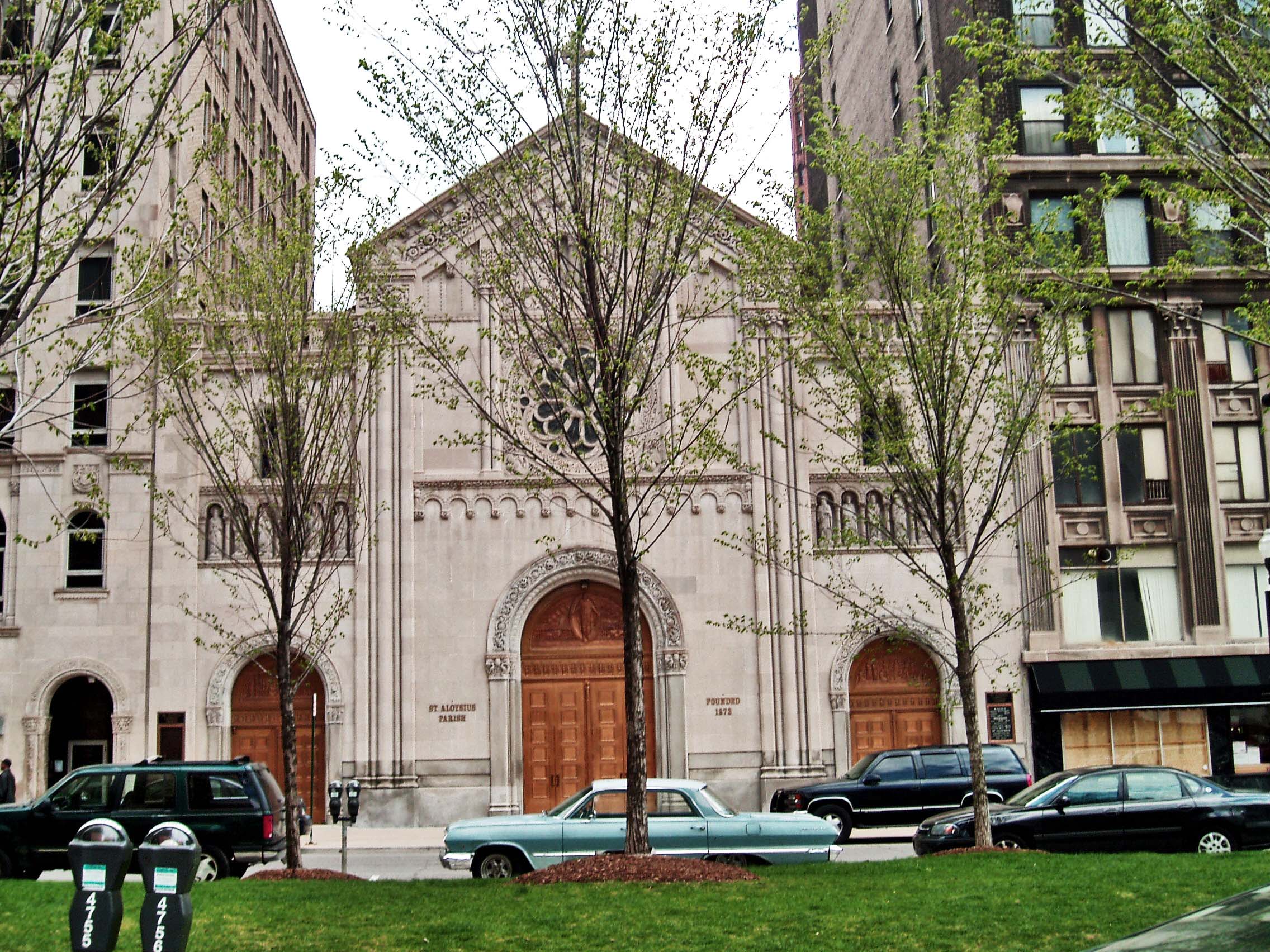
The renovation of Washington Boulevard into the attractive urban blocks we now know began about 1920. The Chancery Building was built to serve as offices for the diocese and completed in 1926. The the former Presbyterian church was razed and replaced by St. Aloysius Church that you see pictured here, one that shares the address of 1234 Washington Boulevard with the Chancery Building.
In the early 1920s, Bishop Gallagher’s major building project was the Sacred Heart Seminary that stands at Linwood and West Chicago. In the late 1920s, his major effort was to construct a cathedral worthy of his prosperous diocese. Unfortunately for him, he never accomplished that goal because the Depression greatly reduced the diocese’ income. Indeed, by 1933, the diocese was bankrupt. However, Bishop Gallagher in the late 1920s had the resources to commission Walter Meier of the John Donaldson and Henry Meier to design the modern and attractive church that you see. Perhaps influenced by the many massive movie theaters that were being built at that time, the architect took the unusual step of using tiered seating in the church. On the Washington Boulevard front, you see the attractive stone work of Detroit’s most accomplish stone artist, Corrado Parducci. As Eric Hill and John Gallagher describe this church in their American Institute of Architects Guide to Detroit Architecture (Detroit, Wayne State University Press, 2003), “The flourishes of corbelling, arcading, and carving stand out from broad planes of unadorned limestone. The rose window is all the more stunning for its context.”
I have not seen the interior of this church but it must be one of the most unusual structure of its kind in the United States. As you can see, the footprint for this building is small but the dioceses wished for a church that would seat many. Walter Meier - son of Detroit architect Henry Meier - desiged a church that could seat 2100 on three levels. There is an altar on first and second level and they may be used one at a time. However, the largest and most impressive altar may be seen from congregants at all levels so it is used when there are many worshipers. The third level is a kind of balcony. There are numerous mosiacs in the interior portraying the symbols of Christianity
For very informative pictures of the interior of this strikingly beautiful church and for additional information, please see the book cited below.
Architect: Walter Meier of the JohnDonaldson- Henry Meier
firm
Architectural style: Romanesque Revival
Mosiacs: Hildreth Meiere
Date of construction: 1930
Use in 2009: Catholic Church
Website: Site: http://www.stalsparishdetroit.org
For additional information see: Marla
Collum, Barbara Krueger and Dorothy Kostuch, Detroit's Historic Places of Worship (Detroit: Wayne State University Press, 2012)
City of Detroit Designated Historic District: Not listed
State of Michigan Registry of Historic Places: St. Aloysius Church is
within the Washington Boulevard Historic
District; P25, 278
National Register of Historic Sites: St. Aloysius Church is within the
Washington Boulevard Historic District, listed July 15, 1983.
Photograph: Ren Farley; May 2, 2009
Description updated: December, 2012