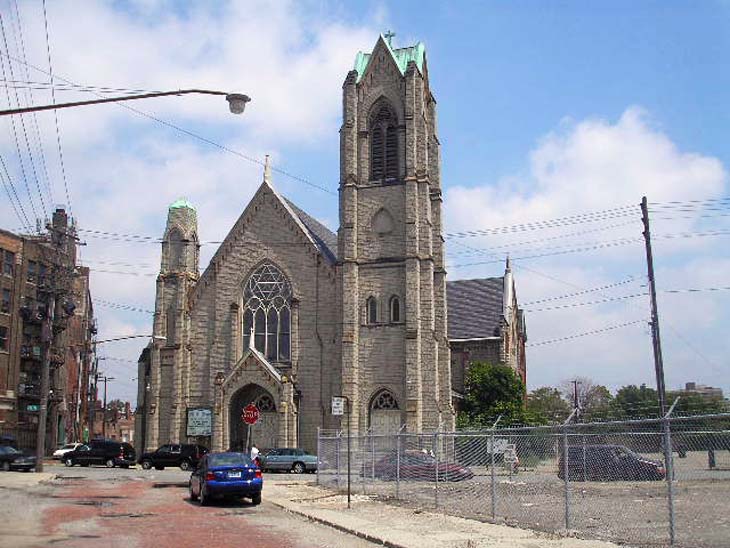
Because of large buildings nearby, it is challenging to appreciate the architectural features of this mature Gothic church. And there is no large space in front of the building to allow you to sense its grandeur. This is the oldest German Protestant congregation in Detroit, founded in 1833. Apparently, a minister was traveling to Ann Arbor but had to spend the week-end in Detroit. German Protestants asked him to preach on Sunday. His oratory must have been convincing since those who heard him decided to establish a church.
The church you see dates from 1874 and is an excellent example of High Victorian Gothic style. The City of Detroit Designated Historic District includes three building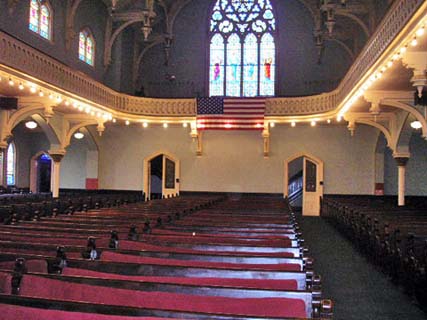 s: the Gothic Church, a Victorian parochial school of three stories and a substantial brick Romanesque Revival parsonage. The original church was built with bricks, but in 1915, it was remodeled. The architect for the more recent work, Hans Gehrke, covered the exterior with the Formstone that you see. Formstone is a plaster or concrete composition made to look like real stones, limestones in the case of St. John’s-St. Luke's. For some reason, the Elders of the congregation must have decided that a faux stone exterior would be more attractive than red bricks. Formstone was once popular as a facing to put on bricks but, I believe, has grown out of favor. Quite a few of the brick row houses in Baltimore are now covered in Formstone.
There is a small tower to the left of the parapeted front gable, while a much more formidable tower is to the left. You see a large lancet window above the gabled vestibule. I have not seen the interior of this church but have read that it is painted in gold and white with extensive Gothic woodwork. It is a great example of High Victorian Gothic style. The pictures of the beautiful interior were provided by an individual who visited this site: Ronald Keeler. The church houses a Votteler Organ; indeed, the historical significance of that organ and the outstanding quality of the interior were among the reasons for the designation of this church as a City of Detroit Historic District. The Historical Register for the State of Michigan reports that this congregation was the mother congregation for 12 other German Protestant Churches in the Detroit Area.
Originally, this was a German Evangelical and Reformed Church. That denomination was also known as The Reformed Church of America. In 1957, that group merged with the Congregational denomination to form the United Church of Christ—a group historically linked to Lutherans. At present there are at least three groups of Congregationalists in the United States. The United Church of Christ is headquartered in Cleveland. An array of churches that did not favor the merger of the Reformed Church with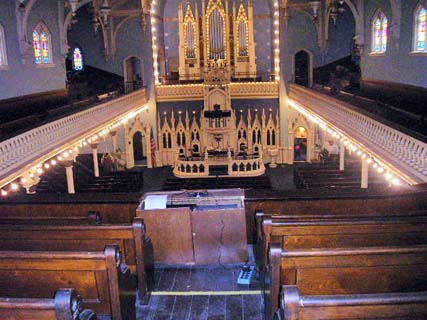 the Congregationalists to form the United Church of Christ, established in 1955, the National Association of Congregational Churches with headquarters in Oak Creek, Wisconsin. Other churches subject to the merger that did not appreciate the liberalism of the United Church of Christ separated to form the Conservative Congregational Christian Conferences, a group with headquarters in Lake Elmo, Minnesota.
Just across Gratiot from the church pictured here is the pleasant campus of Historic Trinity Lutheran. That congregation was founded in the 1850s by members of St. John’s – St. Luke’s who wished to follow a more strict Lutheran doctrine.
There is a great deal of interest in the history of bridges in the United States. A website, http://www.historicbridges.org/index.htm, provides extensive information about several thousand bridges that illustrate the long and fascinating history of building bridges. That website rates historic bridges by whether or not they are threatened; that is, at risk of falling into ruin or being torn down. If there were a website that described the survivability of historically significant churches in Detroit, St. John’s–St. Luke’s would probably be listed as “highly in danger.” I believe that in 2012, a very small group of mature individuals maintained this church. At one time, many elegant churches and synagogues in Detroit were transferred to African-American congregations. With the massive movement of blacks from the city to the suburban ring, it seems unlikely that there will be much demand for church in Detroit from African-American congregation. Young people are moving into downtown Detroit and the one synagogue remaining in Detroit, the Isaac Agree Downtown Synagogue located on Griswold at Capitol Park, has apparently been revitalized by new migrants to the city. I do not know if many or just a few of the young people moving into the Eastern Market condos and other nearby locations are likely to join this United Church of Christ congregation.
Architect: Julian Hess
Date of Construction: 1874
Architectural Style: Victorian Gothic
Architect for 1915 remodeling: Hans Gehrke
Website for St. John’s –St. Luke’s Church: http://www.seamichucc.org/index.php?option=com_content&view=article&id=20%3Ast-johnsst-luke-detroit-mi&catid=10&Itemid=11
City of Detroit Designated Historic District: The interior of this church was formally designated as a historic location on June 25, 1982.
State of Michigan Registry of Historic Places: P4,498
National Register of Historic Sites: # 820002907 Listed April 22, 1982
Use in 2012: Church
Photographs: Ronald Keeler
Description Updated: July, 2012
Return to City of Detroit Historic Designations
Return to National Register of Historic Sites